Research
I chose this project for my portfolio because it showcases my research, problem-solving, and communication skills.
Background
I researched gestalt principles, because they are an important part of information design (the way information is presented).
Gestalt principles are attempts to “explain why the world looks the way it does to ordinary people in natural settings” (Schriver 1997, p.303). Gestalt principles are a key part of the study of visual perception. Visual perception is important to most forms of information design. Information design is crucial to instructional design (designing for education), so I wanted to find out more about the topic to support my goal of becoming an instructional designer.
Research
I searched multiple sources for information on gestalt principles, and very quickly encountered a problem: there was no consensus. There was no single definitive list of gestalt principles. Each source I found claimed a different number of gestalt principles, and even those that did propose the same number, proposed different principles. Even when the principles matched, they had often been given different names.
Problem-solving
I solved this research problem by creating a table to compare the gestalt principles featured in eight popular sources, from different decades and publications*. I combined gestalt principles that explained the same concept but had been given different names, and cross-referenced how many sources each principle featured in, to produce a list of the most popular gestalt principles in information design.
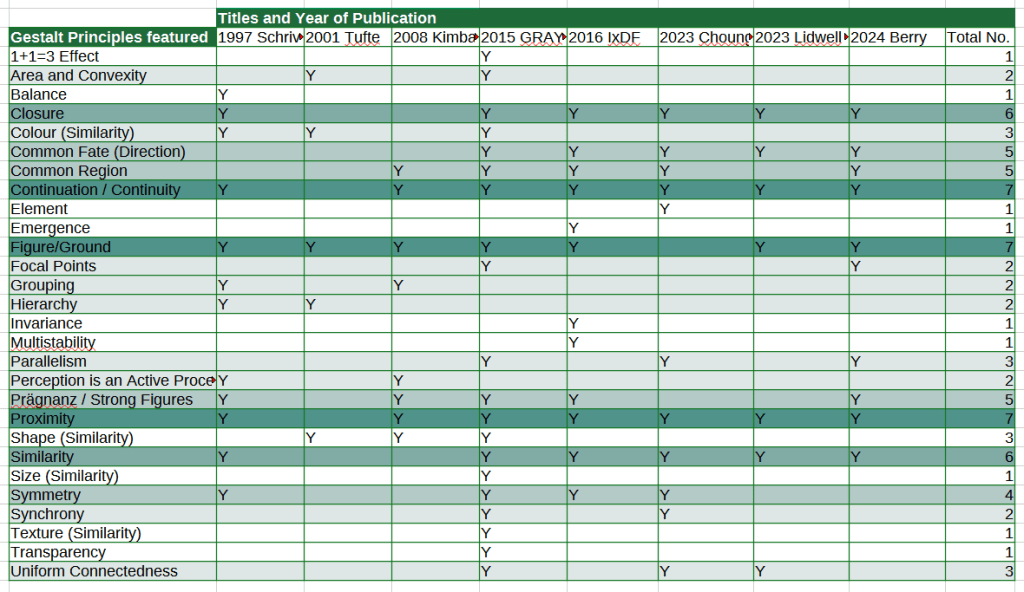
Notes on the table:
1. Where a Gestalt principle is referred to by a different name in different sources, both names have been used in the same row.
2. The Gestalt principles that appear most often have been highlighted in green (darker shades for more common principles).
Communication skills
I explained my research and findings clearly in a literature review document. I also explained each of the most popular gestalt principles, and how each one relates to information design.
Transferable Skills





- Communication: Conveyed my research findings clearly, using text and tables
- Creativity: Added a table to sort through and explain the differing information from different sources
- Critical Thinking: Researched and analysed differing views on gestalt principles to come to a logical conclusion
- Digital: I wrote and formatted the literature review in Microsoft Word, searched for information using Google Scholar and the Glucksman Library website, and presented my results using Microsoft Excel
- Problem Solving: Dealt appropriately with conflicting information
What I learned
I learned more about research, and different approaches I can take to solve research problems.
I learned more about explaining complex topics in an academic manner.
You can read more about the challenges I overcame during this project on my blog.
* The eight sources were: four published books (Schriver 1997; Tufte 2001; Kimball and Hawkins 2008; Lidwell et al. 2023), one peer-reviewed article (Choung et al. 2023), and three information design websites (GRAYBOX Alumni 2015; Interaction Design Foundation 2016; Berry 2024).
References
Berry, R. (2024). Gestalt principles: A guide to the psychology behind stellar UX, Maze, 29 January, [accessed 7 Nov 2024].
Choung, O.-H., Rashal, E., Kunchulia, M., and Herzog, M.H. (2023) ‘Specific gestalt principles cannot explain (un)crowding’, Frontiers in computer science (Lausanne), 5.
GRAYBOX Alumni (2015) Gestalt Principles Applied To Design, Graybox, 19 January, [accessed 07 Nov 2024].
Interaction Design Foundation (2016) What are the Gestalt Principles?, Interaction Design Foundation, [accessed 06 Nov 2024].
Kimball, M.A. and Hawkins, A.R. (2008) Document Design: A Guide for Technical Communicators, Boston: Bedford/St. Martin’s.
Lidwell, W., Holden, K., and Butler, J. (2023) Universal Principles of Design, Updated and Expanded Third Edition: 200 Ways to Increase Appeal, Enhance Usability, Influence Perception, and Make Better Design Decisions., Updated and expanded 3rd ed., Minneapolis: Quarto Publishing Group USA.
Schriver, K.A. (1997) Dynamics in Document Design, New York: Wiley.
Tufte, E.R. (2001) The Visual Display of Quantitative Information, 2nd ed., Cheshire, Conn: Graphics Press.
→
 Michelle Mercier